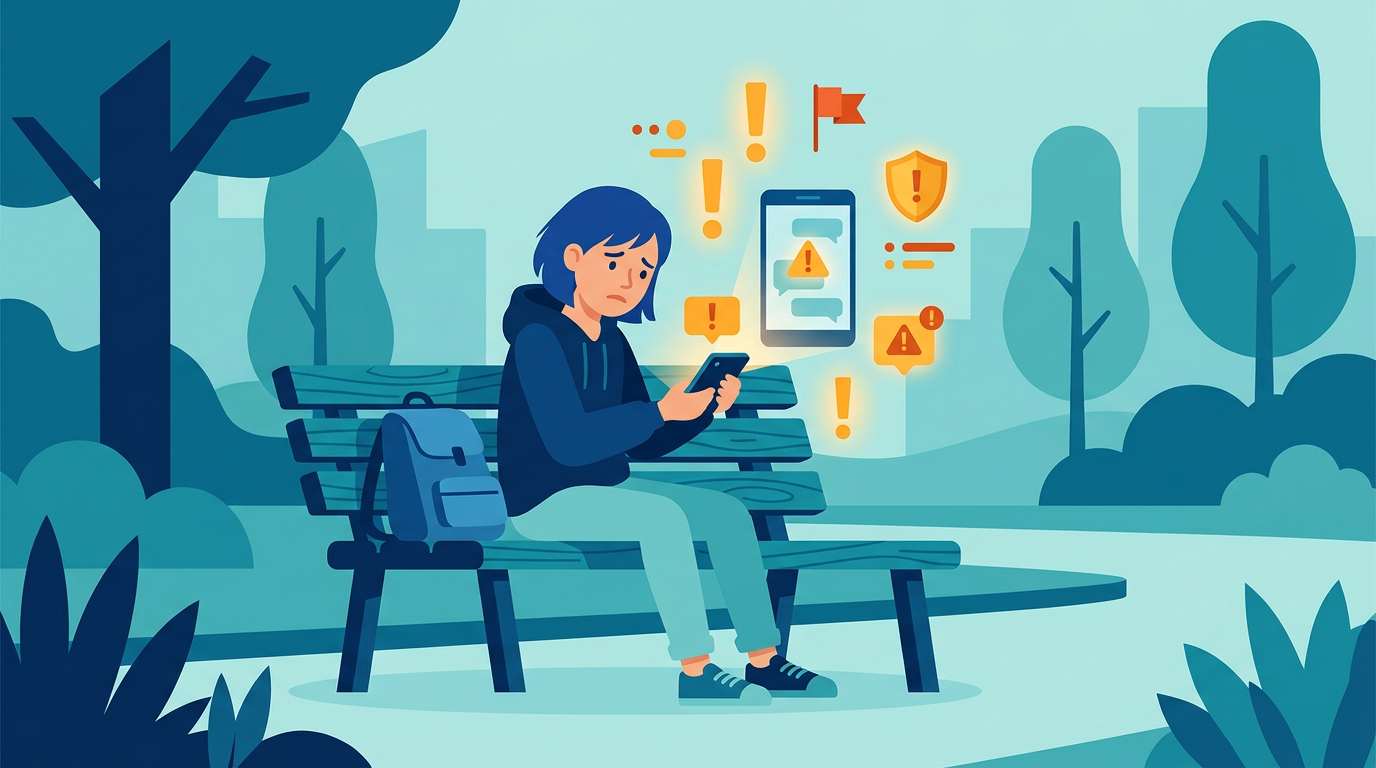

When we talk about cyberbullying, the conversation usually centers on two roles: the bully and the victim. But there is a third role that is far more common and potentially more powerful -- the bystander. Research consistently shows that most young people will witness cyberbullying long before they are targeted by it. What they do in that moment, whether they stay silent or speak up, can determine whether the bullying escalates or stops.
As a parent, you have a unique opportunity to shape how your child responds when they see someone being mistreated online. Teaching your child to be an upstander rather than a passive bystander is one of the most impactful things you can do to combat cyberbullying in your community.
Understanding the Bystander Effect Online
Why Kids Stay Silent
The bystander effect -- the tendency for individuals to avoid intervening when others are present -- is well-documented in psychology. Online, several factors make it even more pronounced:
- Diffusion of responsibility. When a cruel comment has 200 views, your child assumes someone else will say something.
- Fear of retaliation. Children worry that standing up for a victim will make them the next target.
- Social pressure. If the bully is popular or part of your child's friend group, speaking up feels socially risky.
- Uncertainty about what to do. Many children want to help but genuinely do not know how.
- Normalization. Constant exposure to mean-spirited content can make bullying seem like a normal part of online interaction.
The Impact of Silence
When bystanders do nothing, bullying persists. Victims report that knowing others saw what happened and did not intervene is often as painful as the bullying itself. Conversely, research from the University of New Hampshire found that when even one person publicly supports a victim, the bullying is significantly more likely to stop. Your child's voice has more power than they realize.
What Is an Upstander?
An upstander is someone who recognizes when something is wrong and takes action to help. In the context of cyberbullying, being an upstander does not mean confronting the bully aggressively or putting oneself at risk. It means taking deliberate, safe steps to support the person being targeted.
Upstander actions include:
- Sending a private message to the victim to let them know they are not alone.
- Publicly commenting something positive or supportive to counteract the negative messages.
- Not liking, sharing, or amplifying bullying content, even if others are doing so.
- Reporting the behavior to the platform, a teacher, or a trusted adult.
- Telling a parent or trusted adult what they witnessed so an adult can intervene if needed.
How to Teach Your Child to Be an Upstander
Start the Conversation Early
Do not wait until your child witnesses cyberbullying to talk about it. Proactive conversations prepare them to act instinctively when the moment comes.
- Ask open-ended questions: "Have you ever seen someone get picked on online? What happened? How did it make you feel?"
- Share scenarios: "If you saw a classmate getting mean comments on their post, what do you think you could do?"
- Validate the difficulty: "I know speaking up can feel scary. Let's talk about ways to help that feel safe for you."
Teach the "Menu of Options"
Children are more likely to act if they have a clear set of options rather than a vague instruction to "do the right thing." Walk through these choices together:
-
Reach out privately. Send the victim a direct message: "Hey, I saw what happened. That wasn't okay. Are you alright?" This requires minimal social risk and can have an enormous impact on the victim.
-
Redirect the conversation. Post something off-topic or positive in the thread to shift the dynamic. This works especially well in group chats.
-
Report to the platform. Walk your child through the reporting process on the platforms they use. Make sure they know that reports can be made anonymously and that reporting is not "snitching" -- it is using the tools the platform provides.
-
Tell a trusted adult. Reinforce that coming to you, a teacher, or a school counselor is always the right call, especially when the situation feels serious or threatening.
-
Refuse to participate. Sometimes upstanding is as simple as not joining in. Not liking the post, not forwarding the screenshot, not adding to the pile-on.
Practice with Role-Playing
Role-playing might feel awkward at first, but it is one of the most effective ways to prepare children for real situations. Try scenarios like:
- Scenario 1: "Someone in your group chat starts making fun of a classmate's appearance. Others are sending laughing reactions. What do you do?"
- Scenario 2: "A friend shows you a screenshot of another kid's private conversation and wants you to help spread it. How do you respond?"
- Scenario 3: "You see a kid from school getting hateful comments on their social media post from people you don't know. What are your options?"
After each scenario, discuss what felt comfortable, what felt hard, and what the possible outcomes of each choice might be.
Address the Fear Factor
Your child's number one concern will be: "What if I become the target?" Acknowledge this fear honestly.
- Validate it: "That is a real concern, and I understand why you would worry about that."
- Provide perspective: "In most cases, bullies are looking for an easy target. When someone pushes back, even quietly, it disrupts the dynamic."
- Offer a safety net: "If standing up for someone ever causes a problem for you, I want you to tell me immediately. I will always have your back."
- Emphasize the private route: "You do not have to confront anyone publicly. Sending a private message to the victim or reporting to an adult are powerful actions that carry very little personal risk."
Supporting a Child Who Wants to Help
If your child comes to you because they have witnessed cyberbullying and want to do something about it, treat that moment as a gift. They are showing empathy, moral awareness, and trust in you.
- Listen fully before offering advice. Let them describe what happened and how they feel about it.
- Help them choose an action from the menu of options above. Let them decide what feels right rather than dictating the response.
- Follow up. Check back in a few days to ask how the situation developed. Did the bullying stop? Is the victim doing better? Does your child need additional support?
- Praise the instinct. Regardless of the outcome, affirm that caring about someone else's wellbeing is something to be proud of.
When an Adult Needs to Step In
There are situations where a child should not try to handle cyberbullying on their own:
- Threats of physical violence or self-harm. If someone is threatening to hurt themselves or others, an adult must be involved immediately.
- Distribution of intimate images. This is a legal matter that requires adult and potentially law enforcement intervention.
- Persistent, severe harassment. When bullying is ongoing and escalating, adults need to coordinate with schools and platforms to address it.
Make it clear to your child that involving an adult in these situations is not a failure -- it is the most responsible and effective form of upstanding.
Conclusion
Every child who witnesses cyberbullying faces a choice: look away or lean in. As a parent, you cannot make that choice for them, but you can prepare them to make it well. By teaching your child what upstanding looks like, giving them concrete tools to act, and creating a home environment where empathy and courage are valued, you are not just protecting other people's children. You are raising the kind of person who makes every community -- online and offline -- safer and kinder.