
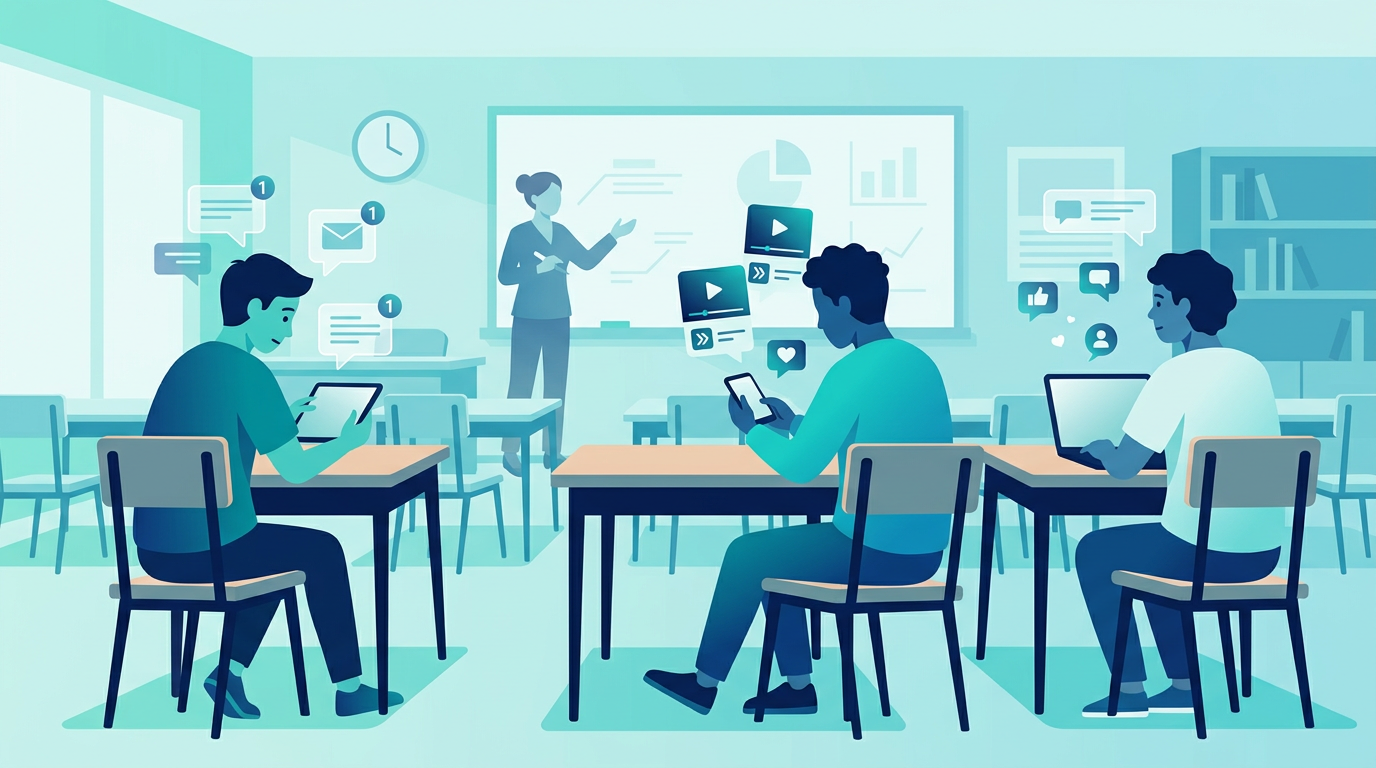
A Classroom Under Siege
Teachers across the country are reporting the same phenomenon: students who struggle to sustain attention for more than a few minutes at a time. Reading assignments go unfinished. Lectures lose their audience within moments. Complex problem-solving feels insurmountable. While attention difficulties in the classroom are not new, the scale and severity of the current challenge are unprecedented -- and the digital environment students inhabit outside of school is a primary driver.
The term "attention fragmentation" describes a pattern in which the brain becomes conditioned to rapid context-switching, short bursts of stimulation, and constant interruption. For a generation raised on push notifications, 15-second videos, and algorithmically optimized content feeds, sustained focus has become an increasingly rare skill.
How Digital Environments Fragment Attention
The Notification Economy
The average teenager's phone generates dozens of notifications per hour -- messages, social media alerts, app updates, and streaks demanding maintenance. Each notification triggers a micro-interruption, pulling attention away from whatever task is at hand. Research shows that even the mere presence of a smartphone on a desk reduces available cognitive capacity, regardless of whether the phone is actively in use.
Over time, this constant interruption trains the brain to expect stimulation at short intervals. When that stimulation is absent -- as in a traditional classroom setting -- students experience restlessness, boredom, and difficulty engaging with material that requires sustained effort.
Short-Form Video and the Shrinking Attention Window
Platforms built around short-form video content have fundamentally altered how young people consume information. These platforms deliver rapid-fire entertainment calibrated to hold attention for seconds, not minutes. The algorithmic feed ensures that the next piece of content is always more engaging than the last, conditioning users to abandon anything that does not immediately captivate.
The cognitive consequence is significant. Students accustomed to this format struggle with longer-form content -- textbook chapters, essay prompts, or multi-step math problems -- because their brains have been trained to disengage when stimulation drops below a certain threshold.
Multitasking as Default Mode
Many students believe they are effective multitaskers, toggling between homework, group chats, music streaming, and social media simultaneously. Cognitive science tells a different story. True multitasking is a myth for complex cognitive work. What students actually experience is rapid task-switching, which degrades performance on every task involved. Studies show that students who frequently media-multitask perform worse on tests of sustained attention and working memory.
The Academic and Behavioral Impact
Declining Reading Stamina
Educators report a measurable decline in students' ability to read extended passages with comprehension. This is not a literacy issue in the traditional sense -- many of these students can decode text fluently. The problem is sustaining cognitive engagement long enough to extract meaning from complex material.
Reduced Depth of Learning
Attention fragmentation favors surface-level processing. Students skim rather than read, memorize rather than understand, and seek quick answers rather than working through reasoning. This has downstream effects on critical thinking, problem-solving, and the ability to synthesize information across sources.
Classroom Behavior Challenges
When students cannot sustain attention, classrooms become harder to manage. Off-task behavior increases, transitions between activities become disruptive, and teachers spend more instructional time redirecting focus. The cumulative effect is a loss of learning time that compounds over weeks and months.
Emotional Regulation
Attention and emotional regulation share overlapping neural pathways. Students with fragmented attention often display heightened impulsivity, lower frustration tolerance, and difficulty managing emotional responses -- patterns that can escalate into disciplinary issues if not addressed at their root.
What Schools Can Do
1. Establish Phone-Free Learning Environments
The single most impactful step a school can take is removing phones from the learning environment during instructional time. Options include:
- Phone pouches or lockers: Students deposit devices at the start of the day or class period
- Classroom phone caddies: Visible, normalized storage that removes the temptation without creating conflict
- School-wide policy: Consistent expectations across all classrooms reduce the burden on individual teachers to enforce rules
Schools that have implemented phone-free policies consistently report improvements in student engagement, classroom behavior, and even social interaction during breaks.
2. Teach Attention as a Skill
Attention is not a fixed trait -- it is a capacity that can be strengthened with practice. Schools can integrate attention-building exercises into the school day:
- Mindfulness practices: Brief, structured mindfulness exercises at the start of class have been shown to improve focus and reduce anxiety
- Gradual endurance building: Start with shorter focused work periods and systematically increase duration, similar to building physical endurance
- Single-tasking challenges: Assign tasks that require sustained, uninterrupted effort and explicitly frame them as attention practice
- Metacognitive reflection: Teach students to notice when their attention wanders and develop personal strategies for re-engaging
3. Redesign Instruction for the Attention Landscape
While the goal should be rebuilding attention capacity, educators also benefit from adapting instructional methods to meet students where they are:
- Chunked instruction: Break lessons into shorter segments with clear transitions and active processing tasks between segments
- Active learning strategies: Incorporate discussion, movement, hands-on activities, and collaborative problem-solving to maintain engagement
- Visual and multimodal content: Use varied media within lessons, but with intentionality -- not as entertainment, but as a tool for deeper understanding
- Purposeful technology use: When devices are used for learning, provide clear structure, time limits, and defined objectives to prevent drift into off-task browsing
4. Educate Students About Their Own Brains
Students are far more receptive to behavioral changes when they understand the science behind them. Age-appropriate lessons on how attention works, how algorithms exploit cognitive vulnerabilities, and how screen habits shape brain development empower students to make more intentional choices.
Topics to cover include:
- The neuroscience of attention and dopamine
- How persuasive design techniques manipulate user behavior
- The real cost of multitasking on academic performance
- Strategies for building a healthier relationship with technology
5. Partner with Families
Attention fragmentation does not stop at the school door. Schools should actively engage parents in the conversation through:
- Data sharing: Communicate research on screen time and attention in accessible formats
- Practical guidance: Help families establish screen-free homework times, device curfews, and notification management strategies
- Consistent messaging: Align school and home expectations so students receive reinforcing signals from both environments
The Bigger Picture
Attention fragmentation is not a problem that schools created, but it is a problem that schools must address. The digital platforms competing for young people's attention are backed by billions of dollars in research and engineering. Schools will not win an arms race against algorithmic engagement. What they can do is build environments where focused attention is valued, practiced, and protected -- and where students develop the self-awareness and skills to manage their own digital lives.
Conclusion
The rise of attention fragmentation represents one of the most significant challenges facing education today. By implementing phone-free policies, teaching attention as a trainable skill, adapting instruction, educating students about their cognitive vulnerabilities, and partnering with families, schools can push back against the forces eroding their students' ability to think deeply. The stakes extend far beyond academic performance -- the capacity for sustained attention is foundational to learning, relationships, and well-being throughout life.