
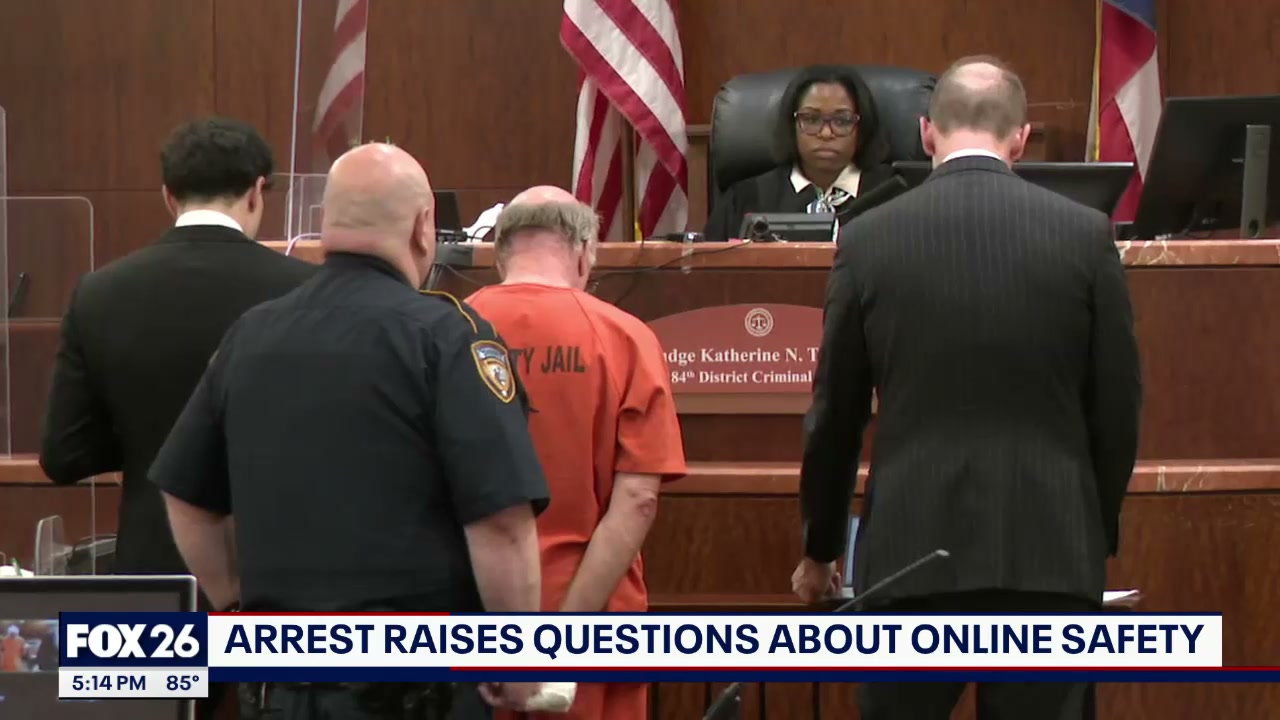
CyberSafely.ai was featured in FOX 26 Houston's recent coverage of a Montgomery County case that has put a renewed spotlight on the digital gap between parents and their children. Reported by FOX 26's Sherman Desselle, the segment looks at how a routine social-media exchange in a quiet suburban neighborhood became the entry point for an attempted crime against a child — and what families and schools can do about it.
You can read the original story on FOX 26 Houston: Is your child safe? What 'The Candyman' arrest reveals about the digital gap in our neighborhoods.
The case in brief
- A 65-year-old Woodlands-area man, known locally to children as "The Candyman," was arrested after allegedly using his familiar neighborhood reputation to solicit a 13-year-old girl through social media.
- The case ended in an arrest only because the teenager told her parents about the messages, prompting investigators to step in.
- Authorities indicated there may be additional victims and asked anyone with information to come forward.
The detail that child-safety experts keep returning to isn't the arrest itself — it's how the contact started. A simple exchange of social-media handles, the modern equivalent of a phone number, opened a direct channel to a child that bypassed every layer of supervision a parent would normally apply to a stranger in their neighborhood.
Why this story matters for families
For many teens, sharing a handle feels like a casual digital handshake. For predators, it's an unsupervised back door. The FOX 26 segment makes a point that is easy to miss in a fast-moving news cycle: the problem isn't a single bad actor in one Texas neighborhood. It's a pattern that any parent, in any community, can be exposed to without realizing it.
The takeaway from the segment isn't that parents are failing — it's that the tools and instincts most of us grew up with weren't built for a world where a stranger can reach a child in seconds from anywhere in the world.
Where AI-driven tools fit in
A meaningful portion of the segment focused on how emerging AI-driven technologies are helping parents close that visibility gap. CyberSafely.ai was highlighted as an example of a tool designed to act as a digital tripwire — quietly monitoring activity across the platforms kids actually use and surfacing alerts when language tied to grooming, predatory contact, self-harm, or other serious risks appears.
The goal isn't to give parents a transcript of every conversation. It's to flag the moments that genuinely warrant attention, so parents can step in early instead of finding out after the fact.
CyberSafely.ai is built around four ideas that came through clearly in the FOX 26 piece:
- Signal, not surveillance. Surface what matters; ignore what doesn't.
- Speed. Alerts arrive in time for a parent to actually do something with them.
- Conversation, not confrontation. Each alert is an opening for a calm, informed talk at home.
- Accessibility. The platform is designed to work for families across income levels and tech-comfort levels, not just the most technical households.
A safety net, not a substitute for the conversation
The strongest message from the segment was that monitoring tools work best when they're paired with an open relationship at home. Ohio school superintendent and child-safety advocate Mike Nutter, interviewed by FOX 26, framed it this way (paraphrased): the value of an alert is that it creates an opening for a conversation — about what's appropriate, what isn't, and what a child should do when something feels wrong.
That's the philosophy CyberSafely.ai is built on. The platform doesn't replace parenting; it makes informed parenting possible at the pace and scale of modern social media.
What parents can take away
Whether or not you caught the original segment, a few practical points stand out for any family:
- Treat a social-media handle like a phone number or a home address. Share it with care, not on reflex.
- Know which platforms your child uses, and how strangers can reach them on each one. The riskiest features are rarely the ones in the headlines.
- Use tools that surface real risks, not noise. Aim for a system that pings you when something genuinely matters, not one that drowns you in data.
- Keep the conversation open. The single most reliable protection against online threats is a child who feels safe telling a parent when something is off.
Continuing the conversation
CyberSafely.ai's inclusion in FOX 26 Houston's reporting is part of an ongoing effort to make the realities of children's online safety understandable to as many families as possible — and to give parents practical, AI-driven tools that work alongside the conversations they're already having at home.
Families in Houston and beyond can learn more about the platform and its resources at cybersafely.ai.